Fish and chips
Fish and chips in Australia is an institution (especially on the Good Friday public holiday, when most places are closed — but not the local chippy! Every year, my friends and I would do an annual Good Friday Fish and Chip Shop Crawl to take advantage of the situation).
While superficially similar, each component differs subtly from the standard fish and chips you would find in the UK. While it makes sense that the Northern Atlantic haddock and cod are swapped for the local barramundi, flake, red emperor, John Dory, snapper, etc., other changes include:
-
Sides such as mushy peas and curry sauce are nonexistent and replaced with potato scallops, calamari, dim sims, and other fried accoutrements.
-
It is pretty common to have alternate options for how you want the fish cooked, such as grilled or crumbed.
-
For sauces, the main sauce of choice is tomato sauce (ketchup), or occasionally tartare sauce.
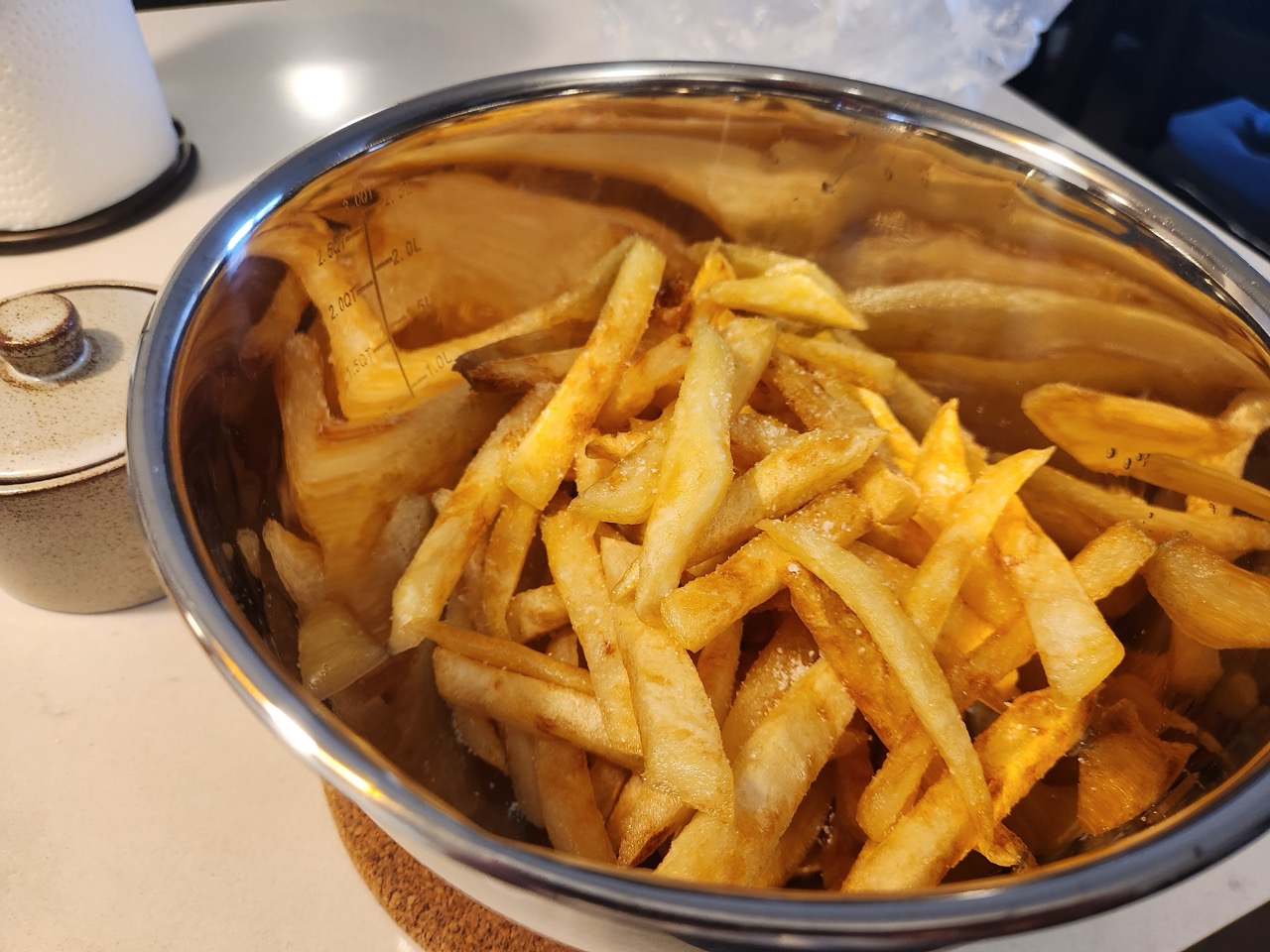
And when it comes to seasoning, lemon wedges are ubiquitous (although white vinegar — not the traditional British malt vinegar — is available). But the seasoning of choice for Australian crispy hot chips (which are fried in vegetable oils, not beef tallow) is chicken salt — a deliciously umami salt blend.
The recipe below is adapted from Brian Lagerstrom’s fish and chip recipe, modified for a more Australian-style fish and chips.
INGREDIENTS
Fish
- 375g firm white fish (such as cod, barramundi, haddock, or snapper), patted dry, portioned, and placed in on a rimmed baking sheet in the fridge.
- 50g flour
- 75g potato starch (or rice flour)
- 100-150ml cold beer
- 1/2 tsp salt
- 1/2 tsp baking powder
Chips
- 3 large starchy potatoes1 (about 600g)
- 2 tbsp vinegar
- 2L cold water
- 1 tbsp salt
Fry
- 2-2.5L of neutral oil
- Chicken salt (or replace with a mix of salt and MSG)
STEPS
-
Peel the potatoes, and cut them into 6-7mm matchsticks2. Place them immediately into a container of water.
-
Stir the potatoes and pour out the starchy water; add more water, and repeat the washing and rinsing until the water runs clear.
Parboil chips
-
Cover with cold water, cover, and place in the fridge for a minimum of 30 minutes and up to 24 hours. This helps to remove as much of the natural potato sugars as possible from the exterior of the chips.
-
Place the chips in a saucepan, and fully cover with cold water. Add the vinegar and the salt, and place over high heat. Once the water just comes to a boil, reduce the heat and leave it to simmer for about 10-12 minutes.
-
Drain the chips and place on a rimmed baking sheet. Pat dry with paper towels, and place in the freezer for 15-30 minutes for them to dry completely.
Chips first fry
-
While the chips are drying, fill a heavy bottomed pot with neutral oil and bring it to 160ºC. The oil should come no more than 6cm up the sides — do not add any more, as the height of the oil will rise significantly when the chips are added due moisture. In my 5.3L Le Creuset dutch oven (about 12cm high), the oil rises to ~10cm when frying.
-
Remove the chips from the freezer, pat dry on both sides one last time with paper towel, and then add them to the oil. The oil temperature should drop to about 140ºC — fry for 5 minutes for the exterior to dehydrate (there should be no browning at this stage). Depending on the volume of potato, you may need to fry in batches to avoid the oil temperature dropping too low.
-
Drain over the same wire rack, and place in the freezer for 30 minutes (alternatively, you can freeze the fries indefinitely at this point).
Fish
-
Heat the oil to 190ºC.
-
In a shallow dish, place about 25g of potato starch. In another small, wide bowl, mix equal amounts of flour and potato starch alongside the salt and baking powder. While whisking, pour in the beer, stopping when you get to a thin pancake batter-like consistency3.
-
Remove the fish from the fridge, and salt each side. Place the fish in the dry dredge, ensuring it is covered all over with potato starch. Shake off the excess, and then submerge the fish in the batter. Allow excess batter to drip off.
-
Slowly lower the battered fish into the oil, waving the submerged portion back and forth, before slowly lowering the fish in and dropping it fully into the oil (away from your body). This process allows the batter to aerate and set before the fish is fully dropped into the oil, ensuring that the fish will float (rather than sinking and sticking to the bottom of the pot). Fry the fish for about 4 minutes, in batches of 2.
-
Drain the fish on a wire rack, and salt it. The fish will remain crispy for about 30 minutes.
Chips second fry
-
Increase the oil temperature to 195ºC.
-
Fry the chips for about 7-8 minutes in batches4 (the temperature should drop to about 170-175ºC), until lightly golden and crisp on the outside.
-
Drain, toss with chicken salt, and serve.
NOTES
Depending on your location, good options are Sebago or brushed potatoes in Australia, Maris Piper in the UK, and Russet in the US and Canada. ↩︎Nagi over at RecipeTin Eats suggests cutting them with a serrated knife to improve final crunchiness. ↩︎You can add an ice cube at this stage to ensure the batter remains cold. ↩︎To keep chips hot while frying in batches, you can keep the rimmed baking sheet in an oven at 90ºC. Or, place the cooked batches in a metal bowl lined with paper towel. ↩︎
This page contains the following recipe components: Hot chips (french fries).