Pastéis de nata
Standard pastéis de nata are baked in large moulds at 400ºC — by using smaller moulds (e.g., a mini-muffin tray), these will bake well in a home oven which cannot get up to such high temperatures. If possible, source a mini-muffin tray made from an aluminimum-steel alloy, as they will retain heat better and lead to a crispier base without overcooking the custard.
INGREDIENTS
Dough
For the dough, anything close to a 2:1:1 ratio of flour, water, and butter should work fine, as in a standard Pâte feuilletée (puff pastry) recipe1.
- 270g plain flour
- 1/4 tsp salt
- 150ml cold water
- 150g unsalted butter (room temperature, stirred until smooth)
Custard
- 25g plain flour or cornflour
- 300ml whole milk (divided)2
- 265g sugar
- 1 cinnamon stick
- 2 inch strip of lemon zest (optional)
- 160ml water
- 1/2 tsp vanilla extract (or a vanilla bean, seeds scraped)
- 6 egg yolks (whisked)
STEPS
Dough
-
In a standmixer fitted with the dough hook, mix the flour, salt, and cold water on low speed until a dough forms that pulls away from the sides of the bowl (about 30 seconds).
-
Pat the dough into a 15cm square on a floured work surface. Flour and cover in plastic wrap for 15 minutes.
-
Roll the dough into a 46cm square, periodically using a bench scraper to make sure it isn’t sticking.
-
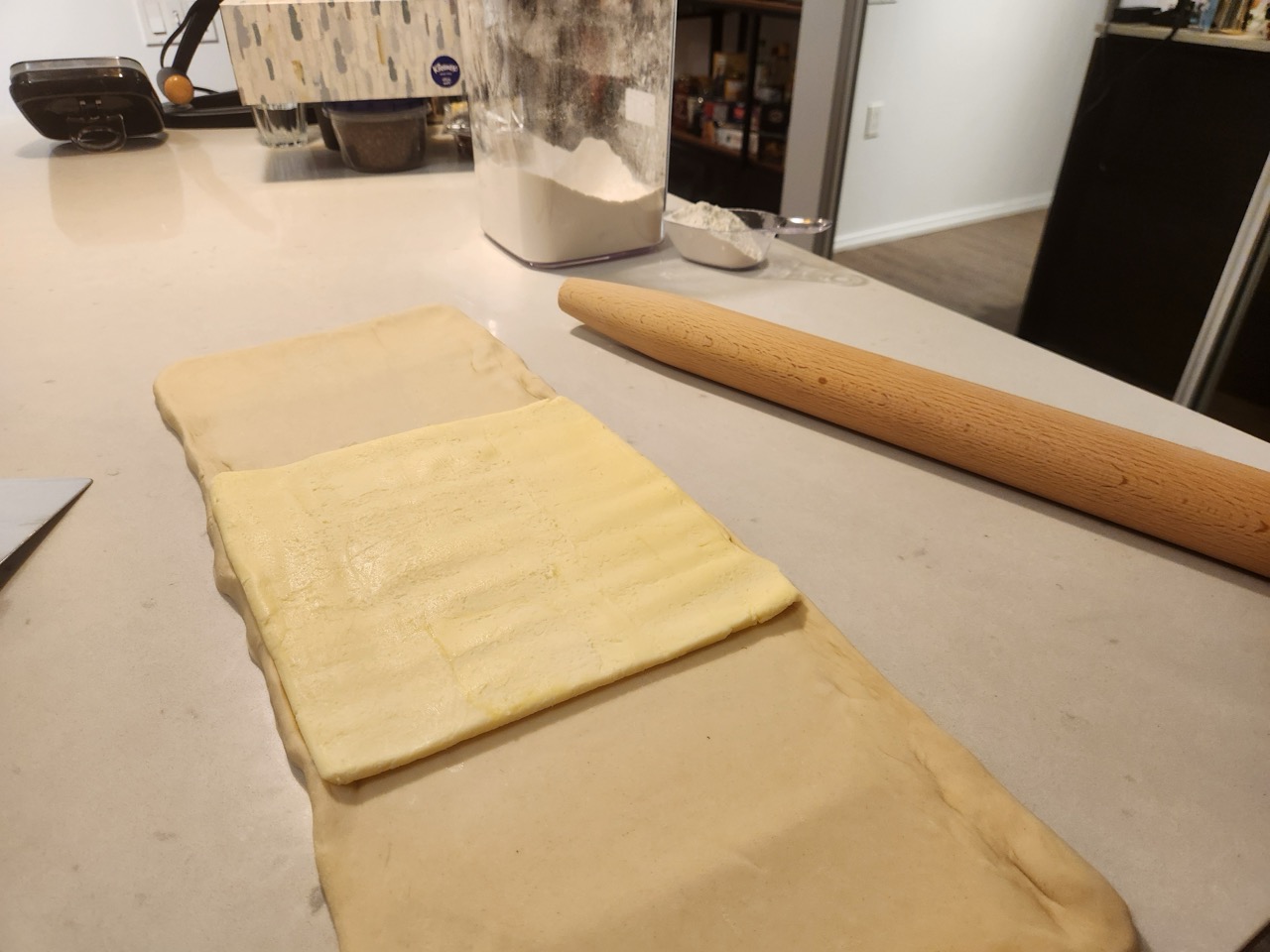
Brush off any excess flour, trim any uneven edges, and spread about a third of the room temperature butter over the left two-thirds of the dough (leaving a 2cm border).
-
Fold the unbuttered right third of the dough over, brush off any excess flour, and then fold over the left third. You should have a long rectangle without any butter visible. Pat the down down with a rolling pin to pop any air bubbles, and then seal the seams of the dough.
-
Turn the dough 90º counter clockwise (the fold should be facing you). Roll the dough out to a 46cm x 53cm rectangle, with the shorter side facing you. Spread the remaining butter over the dough.
-
Carefully lift the edge of the dough closest to you, and roll the dough up in the tight log (brushing any excess flour on the underside as you go). When done, press down to seal the edge of the dough to the log.
-
Trim the ends of the log, cut in half, and tightly wrap in plastic wrap and chill in the fridge for 2 hours and up to overnight. You can also freeze the dough for up to 3 months3.
Custard
-
In a medium-sized bowl, whisk the flour and 60ml of the milk until smooth.
-
In a small saucepan, add the sugar, cinnamon stick, and 170ml of water and cook without stirring until the water has boiled off and you have a sugar syrup — 104ºC. At this point, you should notice that the bubbles have become larger, and take longer to pop.
-
In a microwaveable-safe container, microwave the remaining 250ml of milk until scalding hot, and whisk it into the flour mixture.
-
Remove the cinnamon stick and pour the sugar syrup in a thin stream into the hot milk and flour mixture, whisking continuously. Add the vanilla extract, and continue stirring until it is warm but no longer hot.
-
Whisk in the whisked egg yolks, and then straing the mixture into a bowl. Cover with plastic wrap along the surface (to avoid a skin from forming), and place in the fridge until it is cold4. The custard can be refrigerated for up to 3 days.
Bake
-
Place an oven rack in the top third of the oven, and preheat the oven to its maximum temperature (at least 290ºC) convection for a minimum of 30 minutes.
-
While the oven is preheating, remove a dough log from the fridge and roll it out until about an inch in diameter and 41cm long. Cut the roll into about 20 1.8cm pieces5, and place each piece in a 12-cup mini-muffin pan6.
-
Dip your thumbs into a cup of water, then straight into the middle of the dough spiral. Flatten it against the bottom of the cup, then smooth the dough up the sides and create a raised lip about 3mm above the pan. The pastry bottoms should be thinner than the tops.
-
Fill each cup 3/4 full with the cool custard. Bake until the edges of the dough are frilled and brown — about 9 minutes (12-15 without a convection oven) for the mini-muffin tins, 15-17 minutes for classic egg tart moulds.
-
Remove from the oven, and let cool on a wire rack.
NOTES
The nata can be stored at room temperature for a day, or in the fridge for up to 3 days. To reheat them, pop them in a 180ºC for 5-6 minutes.
Leite’s Culinaria uses a higher hydration dough, 75% (in this recipe, about 200ml of cold water), with a higher percentage of butter, 80% (here about 225g). ↩︎Substituting in some heavy cream, like in the SeriousEats recipe, allows the amount of starch to be reduced — resulting in a more creamy, less jelly-like filling. ↩︎If you plan to freeze the dough, simply disolve tablet(s) of Vitamin C (ascorbic acid — aim for 0.1% of the weight of the flour) in the water used to create the dough, as in the Pâte feuilletée (puff pastry) recipe. This will also avoid the development of brown spots in the flour. ↩︎Cooling the custard helps avoid it overcooking in the oven. ↩︎If using traditional egg tart moulds, cut them into about 15 2.5cm (1 inch) pieces. ↩︎Mini-muffin pan cups are about 50mm diameter by 15mm depth. ↩︎