Pâte à croissant
A leavened Pâte feuilletée (puff pastry), this dough is ideal for making croissants, danishes, and other viennoiserie.

Cooking Schedule
INGREDIENTS
Détrempe
- 500g plain flour (0/T55)
- 140 g water
- 140 g whole milk
- 55 g sugar
- 40 g soft unsalted butter
- 11 g instant yeast
- 12 g salt
Beurrage
- 280g block cold unsalted butter
STEPS
Détrempe
- Combine the dough ingredients and knead for 3 minutes in an electric mixer at low to medium speed, until the dough comes together and you’ve reached the stage of low to moderate gluten development1 Wrap the dough in a 17cm x 34 cm square of baking paper, and roll the dough through the paper until it fits in the corners. Rest in the fridge inside the baking paper envelope until the next day.2
Beurrage
- To prepare the butter block, cut the cold butter (directly from the fridge) lengthwise into thick slabs. Arrange the pieces of butter on waxed paper to form a square of about 15 cm x 15 cm, and wrap in baking paper to form an enclosed square. Pound the butter until it forms a cohesive 17 cm x 17 cm block. Refrigerate the butter slab until needed.3
Lamination
-
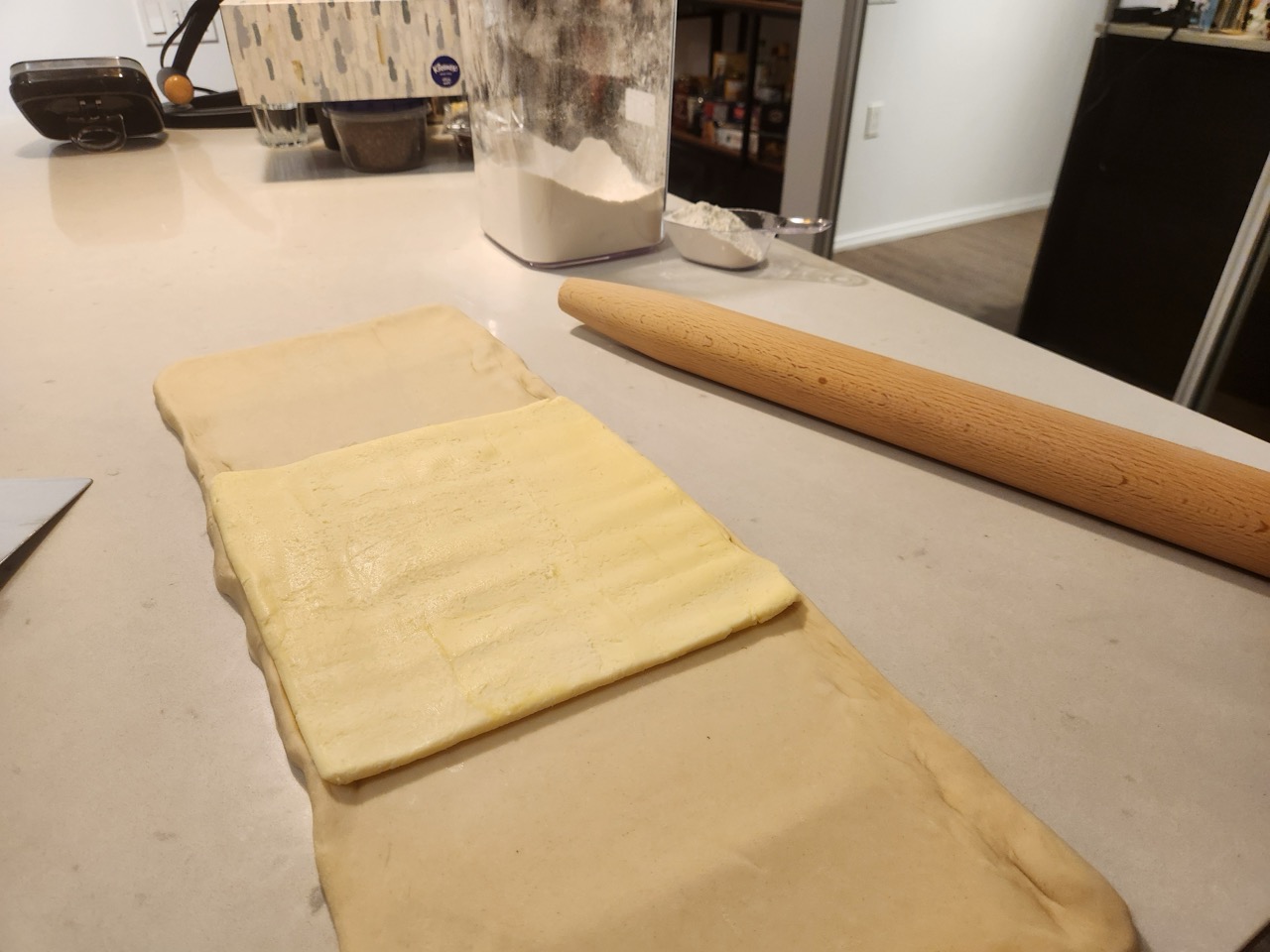
Dust your bench with a little flour (try and be frugal!), and place the dough on the counter. Unwrap the butter block, and place it in the middle of the dough. Fold both ends of the dough over the block and pinch the ends together. You should end up with a 17 x 17cm rectangle, with the butter exposed on the left and right ends, and a tightly sealed seam on the top. Using a sharp pairing knife, cut a slit along each folded edge.
-
Letter fold: Begin rolling the dough from the middle to the top, flouring as needed. Rotate the dough 180 degree and continue to roll middle to top, until you have a rectangle measuring about 20 x 60 cm. Trim the dough on all four sides, and perform a letter fold. Using a sharp pairing knife, cut a slit along each folded edge. Wrap in plastic wrap and refrigerate for 30 minutes to 1 hour.
-
Book fold4: Rotate the dough 90 degrees, so that the exposed butter edges (the uncut edges) are at the top and bottom. Roll out the dough until it is approximately 20 x 70 cm. Fold both ends up to meet a third of the way, then fold the dough it in half again to end up with a block roughly the original size of the butter. Cut a slit along each folded edge. Wrap in plastic wrap, and refrigerate for 2 hours if you performed pointage, or otherwise 24 hours.
Shaping the croissants
-
Remove the croissant dough from the fridge and place on a lightly floured work surface with one short, open side facing you. Dust the top with a little extra flour and begin rolling lengthwise, regularly moving the dough and dusting with flour to ensure it doesn’t stick to the work surface. This final process is the most demanding one. If you’re getting tired or if the dough softens up too much, simply sprinkle the top of the dough with flour, fold it gently over itself and refrigerate until it sets again. Continue the rolling process until you get a long rectangle that measures about 20 x 100 cm and is about 5 mm thick.
-
Before you begin cutting your rolled-out dough (abaisse), fluff it up by running your hand underneath it and lifting it up gently on all sides. This allows the gluten time to relax and stops your cut pieces from shrinking and losing their shape during the cutting process.
-
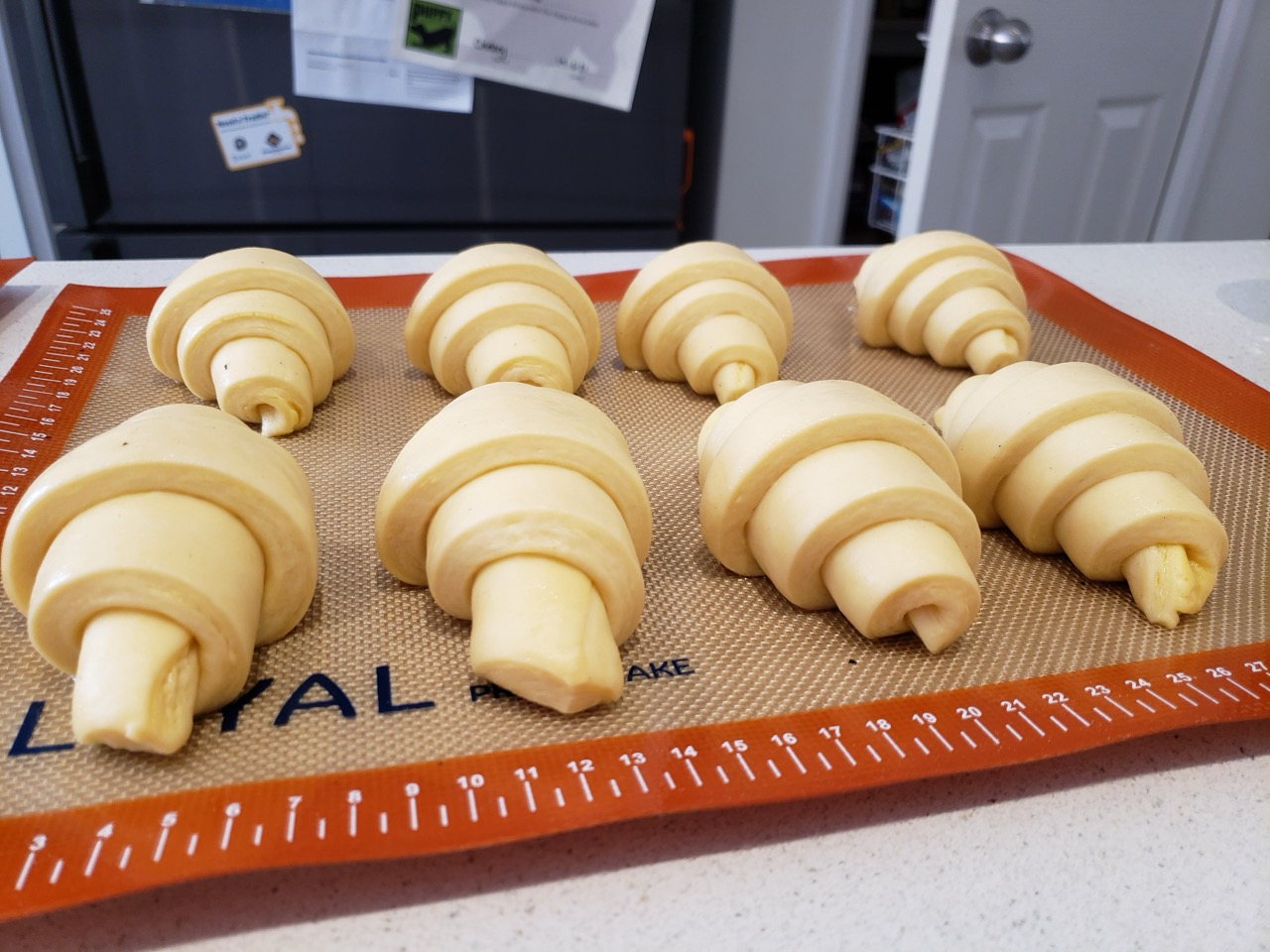
Use a large knife to cut the dough into alternating triangles with a 10 cm base. Gently lift each triangle and stretch it with your hands until they are lengthened by about 10 per cent, to roughly 22-25 cm long. Remove any excess flour from the work surface, as the dough needs to adhere to the surface for the croissants to be rolled properly. Place one triangle on the work surface with the pointed end facing you. Using both palms, roll the wide end (the base) of the croissant towards you, all the way to the tip of the triangle. When the croissant is rolled, simply bend it in the shape of a crescent and place it on a lined baking tray, leaving a 5 cm gap between each.
Proofing and baking
-
Proof the croissants draft-free for about 2 hours at an ideal temperature of 24ºC to 27ºC (above that temperature there is a big chance butter will leak out!)5. You should be able to tell if they are ready by carefully shaking the baking sheet and see if the croissants slightly wiggle. You should also be able to see the layers of dough when looking at your croissants from the side, and they should have doubled in size.
-
Preheat the oven to 200ºC. Brush the croissants generously with the egg wash (being careful to avoid getting egg wash on the exposed layers!6) and bake them at 185ºC for 25 minutes, or until golden brown.
NOTES
You do not want too much gluten development because you will struggle with the dough fighting back during laminating. ↩︎If you want to avoid the overnight rest, you can instead set the dough in a warm place for the first prove (pointage) for 1 hour, or until increased in size by half. The first prove is meant to stimulate the yeast only, so as soon as the dough increases by roughly half of its original size, roll it flat within the baking paper and transfer to the fridge for at least 1 hour. ↩︎Some recipes mix the butter with ~5-6% flour to help create a beurrage that is more pliable and easier to laminate. ↩︎I previously would do 3 letter folds instead of 1 letter fold and 1 book folds, for 27 total layers (rather than 12). However, most recipes recommend 12. ↩︎If you don’t have a proofing box, you can proof them in a turned-off oven with a baking tray of boiling water placed on the bottom. It can be helpful to give them a thin layer of egg wash beforehand to stop them drying out. ↩︎Some bakers place the egg wash in a spray bottle and spray the croissants to get an even layer. ↩︎