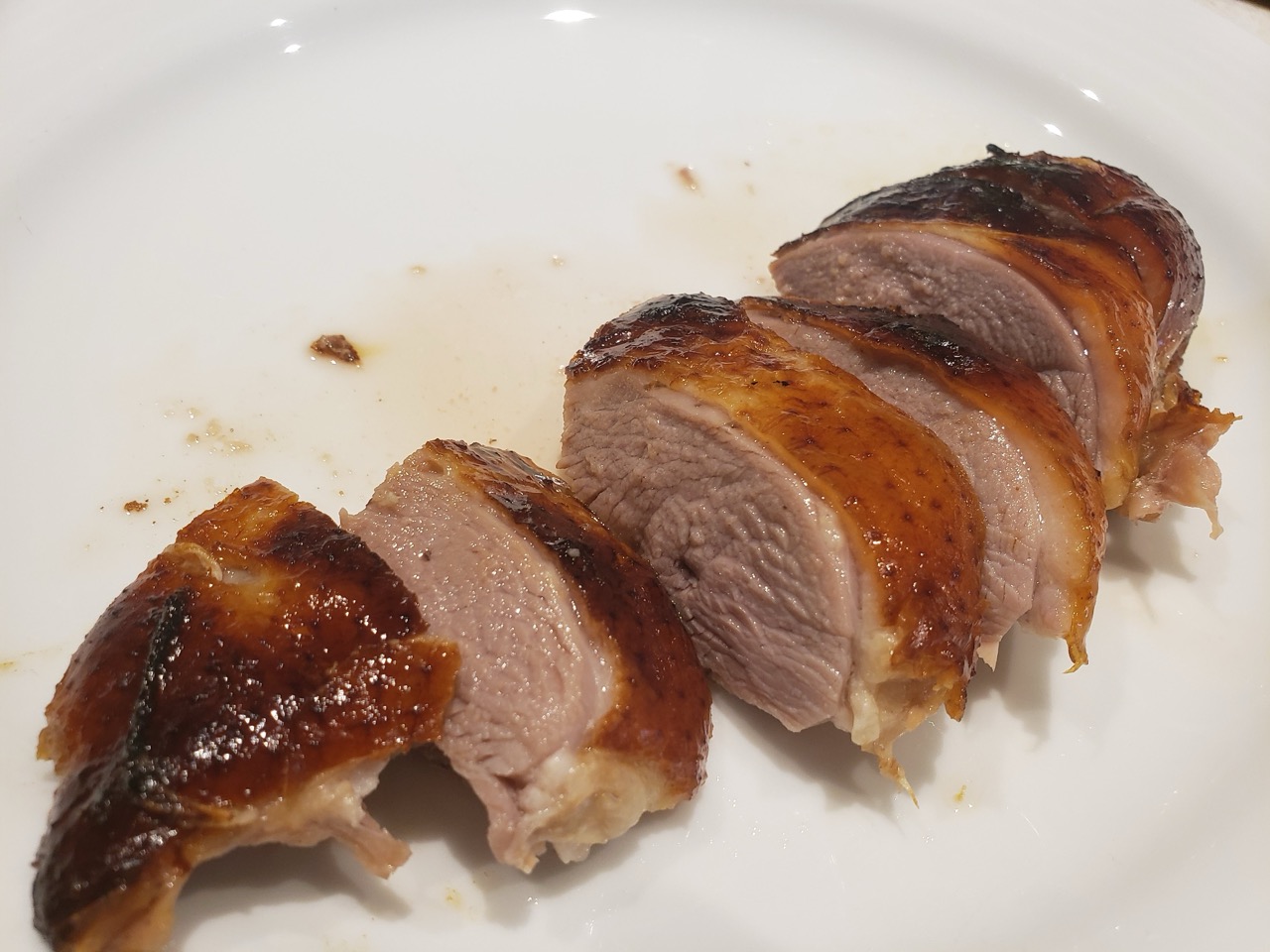
Hong Kong style roast duck
Cantonese roast goose is truly one of my favourite dishes in the world — from the crispy, fatty skin, to the rich dark meat and savoury hoisin-laced drippings, every element of it is perfect. I’ll never forget the roast goose I had in Hong Kong at Yue Kee, one of the last places in Hong Kong to charcoal-roast their goose.
The following is my recipe for approximating roast goose at home, with various shortcuts — swapping the goose for duck, using a kettle for poaching, etc. Of course, if you can buy a goose feel free to use that instead! I used and adapted elements of both the Serious Eats and Chef Steps Peking duck recipes.
Note that unlike western-style roast ducks, where the you want to serve the breast meat medium rare (while cooking the leg meat much longer, a difficult task), Cantonese-style roast duck is much more forgiving, as you serve the duck well done.
Cooking Schedule
INGREDIENTS
- 1 whole duck1
- 2 tbsp kosher salt
- 2 tsp baking powder (optional)
Marinade
- 15g five spice powder
- 4.5g szechuan peppercorns
- 4g cinnamon stick
- 4g fennel seed
- 2g star anise
- 0.5g cloves
- 100g Hoisin sauce
- 15g Kosher salt
- 7g peeled fresh ginger (grated)
- 5g fresh garlic (grated)
- 1 spring onion (green parts, chopped into 3 inch pieces)
Poaching liquid
- 2L Water
- 100g Soy sauce
- 20g Kosher salt
- 8g Star anise (whole)
- 8g Cinnamon stick (whole)
- 8g Fennel seed (whole)
- 2g Szechuan peppercorns (whole)
- 2g Clove (whole)
Glaze
- 100g maltose syrup (can substitute with honey)
- 30g (1 tbsp) soy sauce
STEPS
- Dry duck carefully with paper towels and place on wire rack set in foil-lined rimmed baking sheet. Using fingers or dull handle of a wooden spoon, carefully separate skin from breast meat by inserting fingers through bottom of breasts and slowly working your way up. Be careful not to tear skin. Combine salt and baking powder in small bowl. Sprinkle evenly over all surfaces of duck. Refrigerate duck, uncovered, at least 12 and up to 36 hours until surface is completely dry with leathery appearance.
Marinade
-
If making your own five spice powder, grind the five spices into a spice grinder until a fine powder. Mix the hoisin sauce, five spice powder, ginger, garlic, and 15g of salt to make the cavity rub.
-
Line a sheet pan or countertop with parchment paper. Place your bird on top of the parchment paper, breast-side up, with the cavity open. Pat the duck dry and use tweezers to remove any remaining feathers. Look inside the bird near the tail — there are two glands there that some butchers remove, but if they haven’t been taken out already, remove them, alongside any additional fat. Wearing gloves, spread the marinade everywhere inside the duck’s cavity.
-
Using a bamboo or metal skewer, poke from the outside through the skin on one side, about a centimeter below where the cavity starts near the breast. Weave the pointed end up and over the other side of the cavity, poking through again from the outside, about a centimeter lower than where you started. You should have effectively twisted closed a portion of the cavity with the skewer. Continue poking and weaving, descending about a centimeter each time, always poking through the exterior portion of the bird first, until the entire bird is sewn up. Push the skewer through the sewn skin each time to make sure you leave about an inch or so of the point to stitch with. (The skin will look almost braided.) When there’s no more skin to work with, poke the point of the skewer through the tough, fatty patch of duck at the bottom of the cavity. Break off the blunt portion of the stick that’s still sticking straight up.
Poach
Poaching seasons the skin and shrinks it, giving the duck that taut, perky look we all love and improving the texture by tightening up the pores.
-
Combine ingredients in a large, wide pot, and bring to a boil. Allow to boil for about five minutes to help extract the flavour from the spices.
-
Hold the duck by the head or neck over the water. You might want to grab a stool, because as the goal is to ladle the boiling liquid over the duck’s skin so it tightens up. Ladle the liquid over the entire bird 15 or 20 times until the skin is noticeably tighter and begins to turn a shade or two darker in colour.2.
Glaze
-
Combine the maltose and soy sauce with 1 tablespoon water in small microwave-safe bowl. Microwave on high until maltose is softened, about 20 seconds and stir together until homogeneous.
-
Using a pastry brush, brush the mixture over the duck and rub over entire surface, making sure to coat all exposed skin. Apply a second, slightly thicker, coat by cooling the syrup mixture slightly.
Dry age
- Hang or dry the duck in the fridge for 3-5 days. Place a skewer between the wings, across the back of the bird. This spreads out the skin on the back so it’s drier, and therefore crispier, when you cook it. If you plan to dry your duck lying down, place it on a wire rack lifted a few inches off a parchment-lined baking sheet. If you aren’t hanging the duck, you’ll need to turn it once a day until it’s dry.
Roasting
-
Smoke the duck (optional): Lay the duck breast-side down, with its neck and head curled in the roasting pan. Place applewood chips in a small metal dish inside the roasting pan, next to the bird’s neck. Cover the whole pan with foil, and leave or punch an opening about the size of a silver dollar at the end opposite the wood chips so there is airflow. Lift the foil and light the chips — a blowtorch works great here — then cover for about 30 minutes. Check on the chips every 10 minutes, relighting as necessary.
-
Preheat the oven to 180ºC. Place the duck in a roasting dish on a rack — if possible, try and angle the duck so that the breast is higher than the tail, to allow rendered fat to drip out of the duck. Roast, breast down, for about 45 minutes until the skin is a deep mahogany. Rotate the duck so the breast is now up, and roast for roughly another 45 minutes, placing foil around the wing tips and legs if needed to prevent burning. For the last 30 minutes or so, you can reduce the temperature to 120ºC to make sure all the fat is perfectly rendered.
-
Allow the duck to rest for 10 minutes. Remove the skewer from the cavity, and collect the juices to serve alongside the duck. Carve the duck, and serve alongside rice and kailan.
NOTES
For an even better result (but with much more effort), do the following when roasting the duck:
-
Roast vertically, either on a beer can or hanging from the top of the oven. This allows the duck to cook evenly on both sides, and the rendered fat to drip out of the duck — resulting in extra crispy skin.
-
Fry the outside of the duck after roasting. Preheat a large, shallow pan of canola oil(2-3 inches) to 200 ºC. Holding the head/neck of the duck with oven mitts, use a ladle to pour the hot oil onto the bird on all sides, 10 or 20 times. Give extra attention to the blonder spots on the bird, turning it if necessary, then transfer it to a rack to cool.
When picking a duck, pick a breed that doesn’t have too much fat on it (for example, pick a Pekin duck over a Moulard duck if you have the choice). Also, it is best to find a duck with the head and/or neck still attached, as it will make hanging and poaching the duck much easier. ↩︎Alternatively, I sometimes simplify the poaching step by bringing a full kettle of water to a rolling boil, placing a duck on a wire rack set in sink, and simply pour half of boiling water over top surface of duck, making sure to cover skin evenly, before flipping the duck and repeating. ↩︎