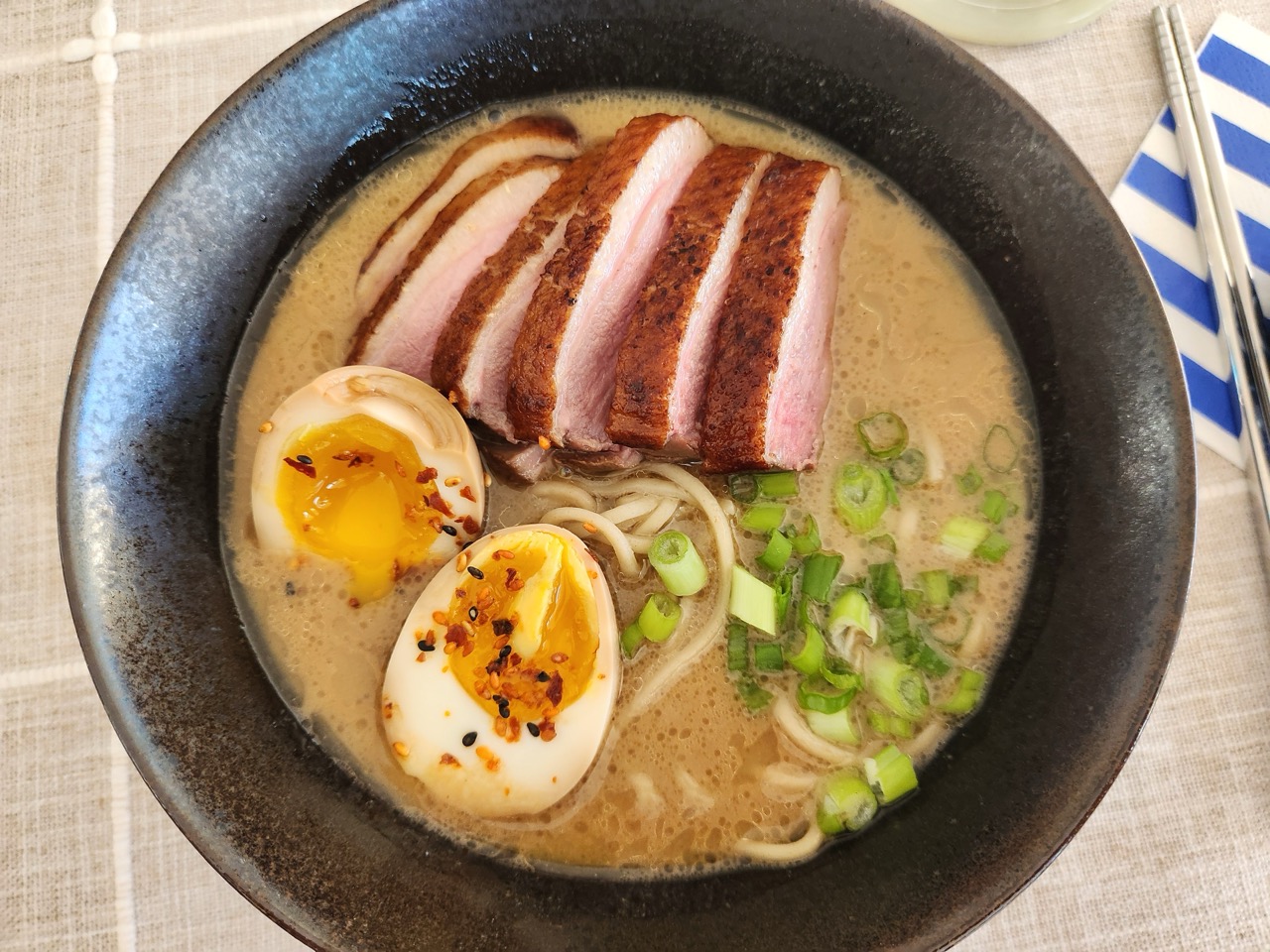
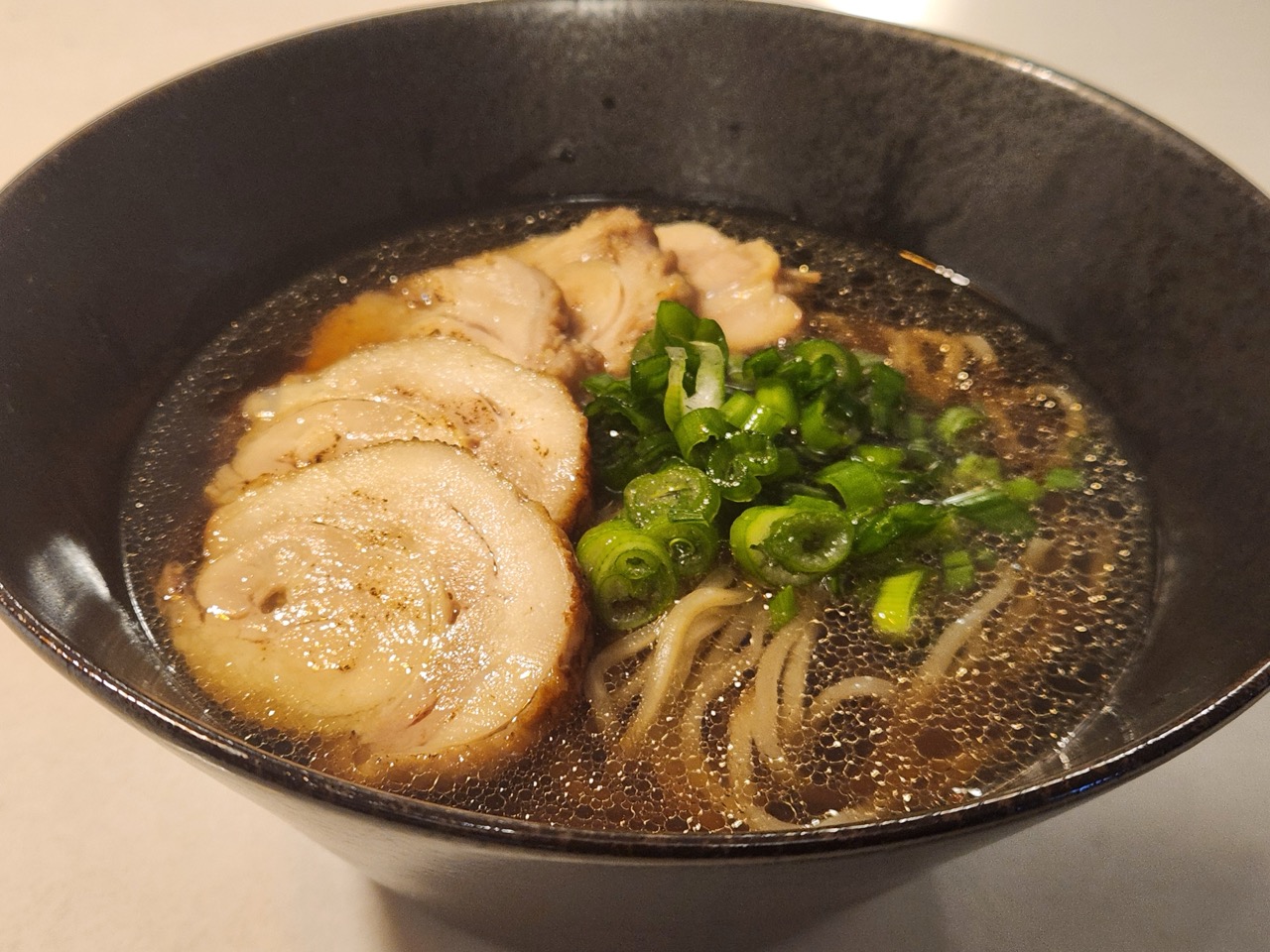
Handmade ramen noodles
Ramen is an alkaline wheat noodle that typically has a 20-40% hydration. The addition of kansui (sodium carbonate and potassium carbonate) adds a subtle alkaline taste to the noodles, whilst giving them a yellow hue and bouncy, elastic ‘al dente’ texture that stands up well to hot broth without going soggy.
This recipe is an adaptation of the 38% hydration noodles from Sho Spaeth’s Homemade Ramen.
Cooking Schedule
INGREDIENTS
- 582g bread flour
- 18g tapioca flour (starch)
- 6g salt
- 6g sodium carbonate1
- 228g water
- Potato starch (for dusting)
STEPS
Mixing
-
Mix the flour and tapioca starch in the bowl of a stand mixer with the paddle attached.
-
Dissolve the salt and sodium carbonate in the water. Set the stand mixer to 2, and slowly stream it into the flour. If necessary, stop the stand mixer and scrape down the sides and the paddle to make sure the dough is being evenly high drated. When done, the mixture should look like course sand; let the mixer run for 1-2 more minutes on low.
-
Place a piece of cling film down on a kitchen counter, approximately 90cm long. Pour the mixture into the center of the cling film, and press it into an approximately 15cm x 60cm rectangle. Using your knuckles, press down all over the dough until it feels cohesive. Wrap the dough rectangle fully in the plastic wrap.
-
Using the heels of your feet (and clean socks!) step all over the dough until it has become a cohesive, pliable piece of dough about 5mm thick. Leave to rest for 1 hour (and up to 8 hours).
Kneading
Due to the low hydration of the dough, a pasta machine is used to ‘knead’ the dough.
-
Divide the dough into 6 equal portions using a bench scraper, and wrap each portion tightly in plastic wrap.
-
Take 2 portions of dough, unwrap them, and feed them through a pasta machine consectutively through the 3 widest settings. Then, stack the two rolled sheets of dough directly on top of each other, and press firmly to adhere them together. Run the combined sheet through the 4 widest settings on the rollers, fold it in half lengthwise, and repeat passing the dough through the 4 widest settings seam-first.
-
Fold the dough in half lengthwise, press down on the seam, and cut the corners off the seam diagonally to ensure it fits in the pasta machine. Pass the sheet seam-first through the 4 widest settings. Repeat this process a minimum of 3 times, and up to 6 times, until the dough is smooth, cohesive, and pliable, and vertical lines have appeared in the dough (indicating gluten development). Fold the sheet into a bundle, and wrap in plastic wrap. Repeat with the remaining portions.
-
Rest the 3 sheet portions for 30 minutes.
Cutting
-
Working one portion at a time, fold the sheet lengthwise in half, press down on the seam, and cut the corners off the seam diagonally to ensure it fits in the pasta machine. Roll the sheet through the pasta rollers from the widest setting, consecutively down until the sheet is 1mm thick (this will be number 7 on a KitchenAid, or number 8 on most manual pasta machines).
-
Cut the sheet in halves, and cut the noodles using the spaghetti cutter attachment. Dust the noodles in potato starch, and form them into loose nests. Each nest should be ~130g.
Aging
-
Place each portion of noodles in small ziplock bags, sealing it most of the way but leaving a small gap to allow the noodles to dry slightly. Leave them out at room temperature overnight, and up to 24 hours.
-
Seal the bags, and transfer them to a fridge to age for 2-5 days.
Cooking
- To cook the noodles, add them to a pot of unsalted boiling water, and agitate them with chopsticks to ensure they don’t stick together. Boil for about 1 minute and 30 seconds, drain, and rinse off the excess starch with cold water.
NOTES
-
After aging, the ramen noodles can be frozen easily and cooked from frozen.
-
It is better to cook the ramen noodles in individual portions (or in separate noodle baskets), as they are much harder to portion out if cooked together.
To make the sodium carbonate, line a baking tray with foil — make sure to note down the weight of the tray and foil. Spread about 70g sodium bicarbonate (baking soda) on the tray, and bake at 175ºC. Every half-an-hour check the weight of baking soda and give it a mix. As soon as it has decreased by a third in weight (down to 47g), the sodium bicarbonate has fully converted to sodium carbonate. Store in an airtight container. ↩︎