Spatchcocked roast turkey with stuffing
Growing up, we would always roast a turkey for Christmas day lunch (typically one of the hottest days of the year in Perth, frequently over 40ºC). I’ve tried so many ways to roast a whole turkey and keep the breast meat moist — dry brine, wet brine, butter under the skin, tray of water in the oven, etc. — and except for one year (where I didn’t put in any effort so have no idea what went right), I was never satisfied.
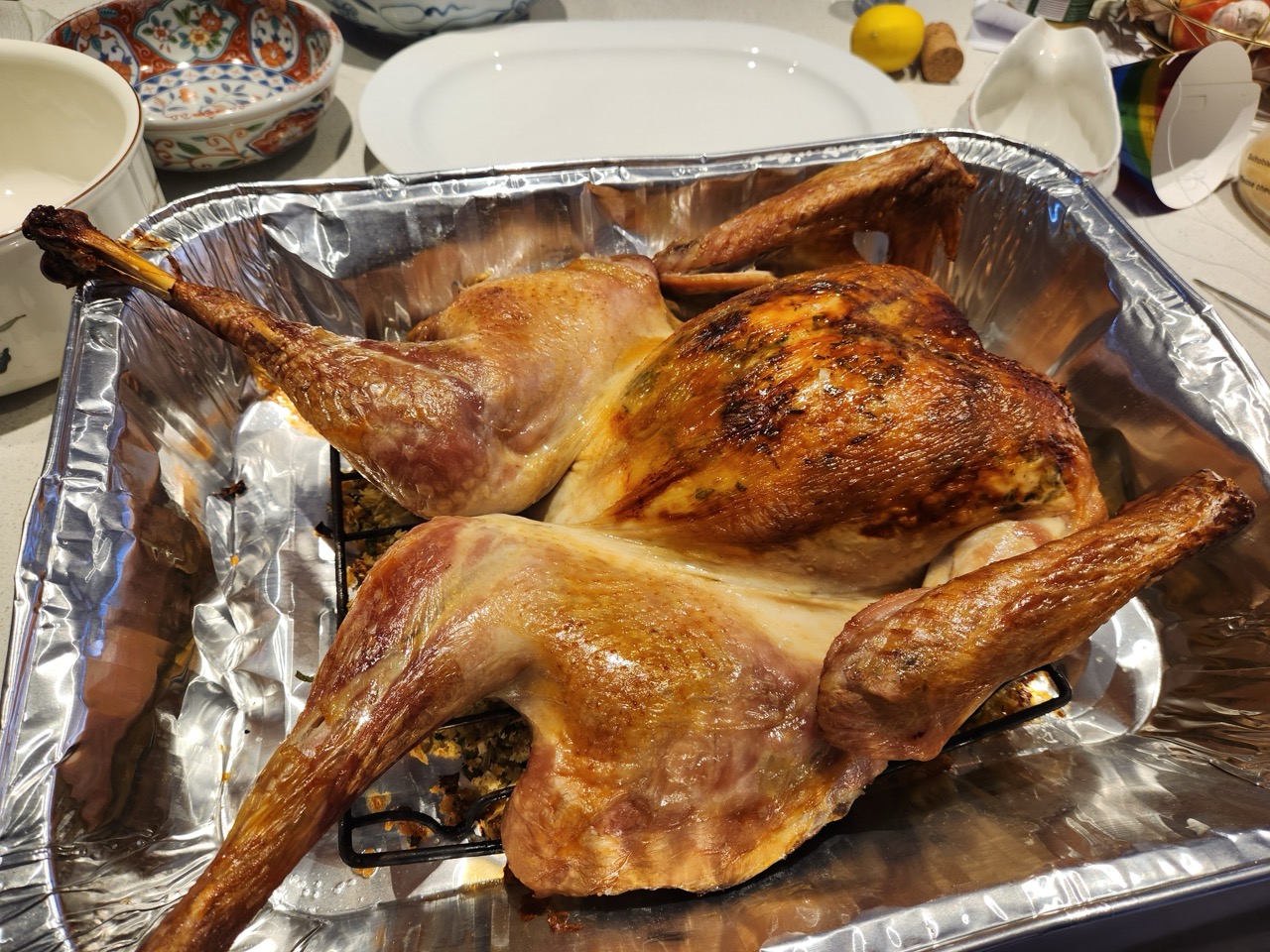
Deciding to spatchcock the turkey was a gamechanger. Not only was the breast meat perfectly juicy, everything was just so much easier. It roasted much faster, I could make the gravy ahead of time, and there was actually room in the oven for roast potatoes at the same time — no need to swelter in the heat cooking the vegetables on the BBQ while the turkey was in the oven.
The recipe below is an amalgamation of a few recipes:
-
The turkey and gravy recipe is adapted from Serious Eats.
-
The stuffing is a recipe from my grandmother, with the addition of chicken rice ginger sauce coming from my mum (her favourite umami bomb).
Spatchcocking the turkey lead to a dilemma, where do we put the stuffing? It came out perfectly delicious simply placing it underneath the spatchcocked turkey. Serve alongside roast potatoes and cranberry sauce.
Cooking Schedule
INGREDIENTS
- 1 whole turkey
- Salt (1.25% of the weight of the turkey)
- 120 g unsalted butter
- Thyme (chopped)
- Sage (chopped)
- Lemon or orange zest
Stuffing
- 1 onion (finely diced)
- 2 sticks celery (finely diced)
- 2 garlic cloves (minced)
- 1 tbsp chicken rice ginger
- 1 lemon
- Parsley
- Thyme
- Rosemary
- Bread crumbs
- Olive oil
Gravy and turkey stock
- 1 carrot (cut into 2 inch pieces)
- 1 celery (cut into 2 inch pieces)
- 1 onion (cut into quarters)
- 2 bay leaves
- 3-4 thyme sprigs
- 45g unsalted butter (about 3 tbsp)
- 30g flour (about 4 tbsp)
- 1L homemade chicken stock or store bought low-sodium chicken or turkey stock (optional)
- Wine (optional)
STEPS
Dry brine the turkey
-
Cut the backbone out of the turkey. Flip it around, and press down on the breastbone to flatten the turkey. Cut off the wingtips, and save this with the backbone for the turkey stock.
-
Place the turkey in a baking tray, dry it with paper towels, and cover evenly with the salt — including underneath. Leave uncovered in the fridge for 24-48 hours.
-
Soften the butter, and mix in the chopped thyme, sage, lemon or orange zest, and black pepper. Rub the herb butter all over the turkey and under the skin. At this point, you can continue on and roast the turkey that day, or leave it overnight uncovered in the fridge to roast the next morning.
Turkey stock
-
Cut the backbone into 2 inch sections. Heat a tablespoon of oil in a roughly 3L saucepan over high heat, and add the chopped turkey parts (backbone, wingtips, and other parts you might have), stirring occasionally until browned (5 minutes).
-
Add onions, carrots, and celery, and cook until softened (another 5 minutes).
-
Add chicken or turkey stock, thyme, and bay leaves. Bring to a boil and reduce to a bare simmer. Allow to cook 45 minutes, then strain through a fine-mesh strainer into a 2L liquid measuring cup and discard solids. Skim off any fat from the surface of the broth and keep in the fridge.
Prepare the stuffing
-
Use a food processor to coarsely blend the stale bread.
-
Gently fry the onion, celery, garlic cloves, and chicken rice ginger, in olive oil until soft and golden brown.
-
Add the fried onion and celery to the breadcrumb mixture, alongside parsley, rosemary, thyme, salt, pepper, olive oil, and a squeeze of lemon/lemon zest to taste.
Roasting the turkey
-
Preheat the oven to 230ºC.
-
Place the stuffing in a baking tray, and place a wire rack directly on top of the stuffing with the turkey on top. Optionally, poor a little water, stock, or white wine into the baking tray to stop the stuffing and drippings from burning.
-
Transfer turkey to oven and roast, rotating occasionally, until an instant read thermometer inserted into the deepest part of the breast registers 150ºF (66ºC), and the thighs register at least 165ºF (74ºC), about 60-80 minutes depending on the size of the turkey. As a rough rule of thumb, 10 minutes per 500g.
-
When turkey is cooked, remove from oven and transfer rack to a new baking sheet, and move the stuffing to a separate serving bowl. Allow the turkey to rest at room temperature for 20 minutes before carving — do not use foil, this will cause the skin to go soggy!
Gravy
-
While the turkey is resting, make the gravy. Melt butter over medium-high heat in a 2L saucepan. Add flour and cook, stirring constantly until flour is golden brown, about 3 minutes.
-
Whisking constantly, add broth in a thin, steady stream until it is all incorporated (you can optionally add some wine as well). Bring to a boil, reduce to a simmer, and cook until reduced to about 1L, about 20 minutes longer. Season to taste with salt, pepper and MSG, cover, and keep gravy warm.
-
Carefully pour any collected juices from out of the roasting pan through a fine-mesh strainer into a liquid measuring cup1. Skim off excess fat and discard. Whisk juices into gravy.
NOTES
If you would like to roast the turkey whole, go for it! Simply follow the steps as is, but place the stuffing inside the turkey. Cover the turkey with foil, and place in the oven on the top rack (with a tray of water below to add moisture and stop the turkey from dying out).
The turkey should require approximate 20-25 minutes per 500g, working out to about 4 hours for a 5.2kg turkey. Every hour or so, take the turkey out and baste it with the pan drippings. If the drippings start drying out, add a bit of stock to the pan. For the last 40-45 minutes, remove the foil and the baking tray of water to crisp up the skin (can also turn up the temperature to 200ºC).
There might not be much — the stuffing would have soaked up a lot. ↩︎